3-6 Year Preschool Toy Selection: Ignite Their Imagination
Children love to imitate during the preschool period. A guide to profession sets, dolls, and imaginative role-playing toys for the 3-6 age group.
3-6 Year Preschool Toy Selection: Ignite Their Imagination
Ages 3-6 represent one of the most enjoyable periods when children begin to become “individuals,” socialize, and imitate adults. This period is also called the “Magical Years” or “Play Age” because a cardboard box can become a spaceship for them, and a simple plastic wand can transform into a magic staff.
In this guide, we’ll examine in detail the developmental characteristics of the 3-6 age group and appropriate toy categories for this period.
Developmental Characteristics of the 3-6 Year Period
Cognitive Development
During this period, children:
- Develop symbolic thinking (one object can represent another)
- May have imaginary friends
- Begin to understand cause-and-effect relationships
- Can do simple categorization (colors, shapes, sizes)
- Get acquainted with numbers and letters
- Attention span extends (can focus for 15-20 minutes)
Social-Emotional Development
- Peer relationships become important
- Sharing and taking turns begin to be learned
- Empathy develops
- Different perspectives are tried through role-playing
- Self-confidence begins to form
- Desire for independence increases
Language Development
- Vocabulary rapidly expands (2,000-6,000 words)
- Can form complex sentences
- Can tell and listen to stories
- Asks questions (Why? How? When?)
- Can have imaginary dialogues
Toy Categories and Benefits
1. Role-Playing (Dramatic Play) Toys
Children learn by imitating the world. “House” or “Profession” games develop empathy, communication skills, and problem-solving.
Profession Sets
Doctor, mechanic, chef, police, firefighter, veterinarian sets… These sets provide children with many benefits:
Developmental benefits:
- Fear management: A child afraid of doctors overcomes their fear by taking on the doctor role
- Sense of responsibility: Taking care of the “patient” teaches empathy and responsibility
- Learning professions: Understanding social roles and functions
- Language development: Learning profession-specific vocabulary
- Problem-solving: Developing thinking skills with questions like “How can I heal the patient?”
Example play scenarios:
- “What’s wrong with your patient, doctor?”
- “This car’s engine is broken, can you fix it?”
- “What’s on our menu today, chef?”
Kitchen and Tea Sets
Plastic kitchen sets, tea services, food replicas…
Developmental benefits:
- Social skills: “Serving tea” teaches hospitality and manners
- Mathematical concepts: “How many plates do we need?”, “How many pieces should the cake be?”
- Sequencing and planning: Steps of meal preparation
- Fine motor: Holding small pieces, pouring
- Nutrition awareness: Opportunity to discuss healthy and unhealthy foods
Market and Cash Register Sets
Cash register, barcode reader, plastic money, market shelves…
Developmental benefits:
- Math foundation: Counting, recognizing money, simple addition-subtraction
- Social roles: Customer-seller relationship, polite behavior
- Real-life skills: Shopping concept, budget awareness
- Communication: Taking orders, saying thank you
2. Character and Figure Toys
Dolls and Accessories
Dolls, strollers, cribs, clothing sets, bottles, and feeding sets…
Why they’re important:
- Caregiving instinct: Valuable for both boys and girls
- Developing empathy: Meeting the doll’s “needs”
- Daily routines: Acting out sleep, feeding, bathing activities
- Expressing emotions: Projecting their feelings onto the doll
Note: Doll toys aren’t just for girls. Boys developing caregiving skills contributes to them becoming more compassionate individuals in the future.
Action Figures
Superheroes, animal figures, vehicle and driver sets…
Developmental benefits:
- Story creation: Children write their own scenarios
- Good-evil concept: Moral concepts through superhero games
- Hand-eye coordination: Manipulating figures
- Imagination: Creating adventures
Toy Houses and Garages
Multi-story toy houses, vehicle garages, farm sets, castle and fortress sets…
Developmental benefits:
- Spatial thinking: Space concept, inside-outside, up-down
- Organization: Placing items, creating order
- Extended play: Extends attention span
- Social play: Multiple children can play together
3. Building and Construction Toys
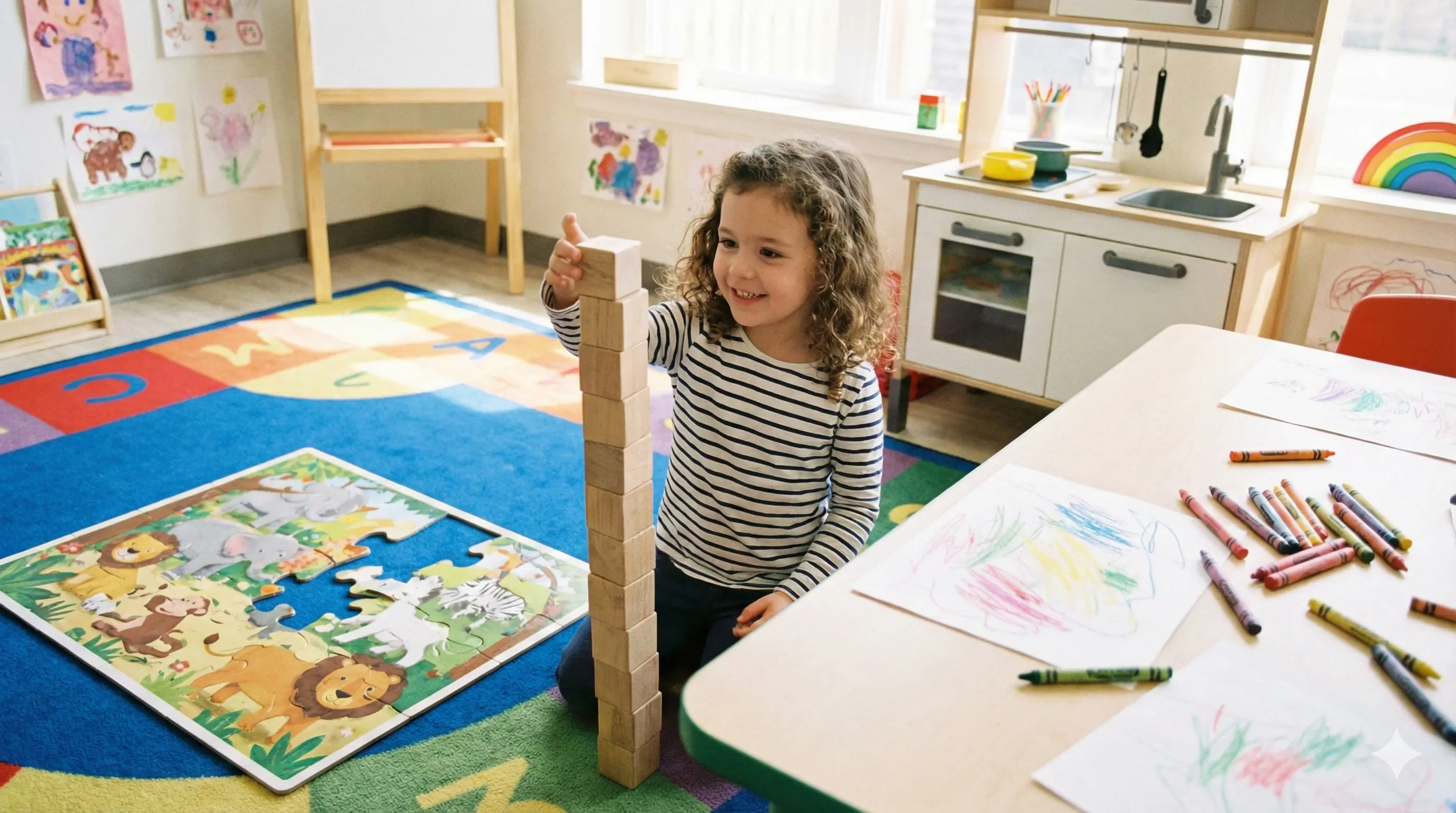
Blocks that were just “stacked” at ages 1-3 now become “meaningful structures” at ages 3-6.
Building Blocks
Classic wooden blocks, interlocking plastic blocks, magnetic building sets…
Developmental benefits:
- Spatial intelligence: 3D thinking
- Planning: “What kind of castle can I build?”
- Problem-solving: Seeking solutions when the structure loses balance
- Math foundation: Geometry, symmetry, measurement concepts
- Physics foundation: Balance, weight, stability
- Creativity: Open-ended building possibilities
Expectations by age:
- 3 years: Simple towers and horizontal structures
- 4 years: Bridges, enclosed structures
- 5 years: Complex structures, symmetrical designs
- 6 years: Planned projects, detailed models
Track and Rail Sets
Wooden train tracks, car tracks, marble runs…
Developmental benefits:
- Cause-effect: What happens when I drop the ball?
- Engineering foundation: Connection points, inclines
- Patience: Process of connecting parts
- Cooperation: Coordination in group play
4. Art and Creativity Materials
Play Dough and Clay
Developmental benefits:
- Fine motor: Kneading, shaping
- Sensory experience: Different textures
- Creativity: 3D art
- Stress relief: Therapeutic effect
Painting and Drawing Materials
Crayons, markers, watercolors, coloring books…
Developmental benefits:
- Hand-eye coordination: Coloring within boundaries
- Color recognition: Color names and mixtures
- Self-expression: Drawing emotions
- Writing preparation: Pencil-holding skills
5. Outdoor and Physical Activity Toys
Tricycles and Scooters
Developmental benefits:
- Gross motor: Leg strength, coordination
- Balance: Vestibular system development
- Independence: Pride in moving on their own
- Spatial perception: Navigation, distance estimation
Ball Games and Sports Sets
Basketball hoops, soccer goals, bowling sets, badminton…
Developmental benefits:
- Team spirit: Playing together
- Rule following: Following game rules
- Competition and fair play: Learning to win and lose
- Physical health: Active lifestyle habits
Play Instead of Screens: Practical Strategies
The biggest problem parents face in this era is screen addiction. The way to pull a 3-6 year old away from screens is to give them an active task and a sense of involvement.
Effective strategies:
-
Give real tasks:
- “The table leg seems loose, can you check it with your repair kit?”
- “Can you help me wash potatoes for dinner?”
-
Get involved in play:
- Even 10 minutes of playing together with your child is more valuable than 1 hour of playing alone
-
Create play corners:
- A permanent kitchen corner, reading corner, construction corner
- Everything should be ready and accessible
-
Establish routines:
- “30 minutes of playtime before dinner”
- Clear limits for screen time too
-
Give choice:
- “What do you want to play now: blocks or dolls?”
- Sense of autonomy reduces screen appeal
Breaking Gender Stereotypes
It’s important not to get caught up in gender stereotypes when choosing toys:
- A girl can play with repair kits and vehicles → engineering interest
- A boy can play with kitchen sets and dolls → caregiving skills
Research shows:
- Children who play with various toys develop a wider skill set
- Children not exposed to stereotypes are more creative
- Both genders need the same basic skills
Toy Selection Criteria
Quality and Durability
- Toys for the 3-6 age group are subjected to heavy use
- Choose well-made products from quality plastic that don’t break easily
- Parts should have sturdy assembly
- Should be washable and cleanable
Safety
- CE mark is essential
- Be careful of small parts if there’s a sibling under 3
- Should not have sharp edges
- Paints should be non-toxic
Open-Endedness
- Instead of toys played only one way, choose toys that can be used in different ways
- Example: A doll can be used in 100 different scenarios; a battery-operated toy that makes only one sound gets boring quickly
Age Appropriateness
- Consider the age recommendation on the packaging
- Too easy = boring, too hard = frustration
- Ideal is slightly above the child’s current skill level
Frequently Asked Questions
1. My child keeps playing with the same toy, is this normal? Yes, obsessively playing with the same toy or role (like constantly being a firefighter) at this age is an effort to learn that subject deeply. This is a natural part of the “schema” development process and is not concerning.
2. They’re having trouble sharing toys, what should I do? Learning to share takes time and isn’t fully developed at ages 3-4. Toys with multiple parts (like a box of blocks or tea set) are ideal for practicing “one for you, one for me.” Instead of forcing, be a role model and be patient.
3. How many toys is enough? Less is often more. Too many toys:
- Distract attention
- Reduce creativity (imagination isn’t used when everything is ready)
- Teach not to value things Apply a rotation system: store some toys and periodically switch them out.
4. Are electronic toys harmful? Not completely harmful but should be chosen carefully:
- Avoid: Toys based on passive watching, single-button operation
- Prefer: Electronic toys requiring active participation with multiple functions
- General rule: The child should control the toy, not the other way around
5. Should I buy violent toys (guns, swords, etc.)? This is a controversial topic:
- Completely banning may create a “forbidden fruit” effect
- Allowing may normalize violence, some worry
- Middle ground: Talk with your child, discuss good-evil concepts
- Research: Violence-themed play (hero-monster) can help children process their fears
6. Can second-hand toys be purchased? They can be purchased with hygiene checks:
- Plastic toys can be disinfected
- Fabric toys can be washed
- Check for missing parts
- Check safety standards compliance (old toys may not meet current standards)
Conclusion
The 3-6 year period is when play is most valuable. During this period, children:
- Discover who they are
- Learn how to relate to others
- Develop their creativity
- Lay the foundation for future learning
The right toys are tools that support this development. But remember: The best toy is the time you spend with your child. Your involvement in play is much more valuable than expensive toys.
At Erdem Toys, we support your child’s healthy development with our CE certified and educational products specially designed for the preschool period.
This guide has been prepared in accordance with preschool education experts’ recommendations. Every child is individual; interests and development rates may vary.