10 Educational Home Activities with Ball Pit Balls
Simple and fun game ideas to develop your child's motor skills using colorful balls at home. Montessori-inspired home activities.
10 Educational Home Activities with Ball Pit Balls
Ball pit balls are the perfect ingredient for countless educational activities that can be done with children at home. These colorful, lightweight, and safe materials are ideal for both entertaining and developmental games.
Especially during winter months or days when you can’t go outside, you can both entertain your child and contribute to their development with the balls at your disposal.
In this guide, you’ll find 10 simple and educational game suggestions you can prepare when your child is bored.
Why Ball Pit Balls?
There are several reasons why ball pit balls are ideal for home activities:
Safety
- Being lightweight, they won’t cause harm when thrown
- Soft plastic doesn’t damage furniture when hit
- Large enough not to create a choking hazard (standard sizes)
- Non-toxic material (in quality products)
Versatility
- Natural tool for teaching colors
- Can be used to teach counting
- Develops motor skills
- Provides sensory experience
- Can be played alone or in groups
Economical
- Buy once, use for years
- Can be adapted to different games
- Requires no additional materials
- Easy to store and clean
Activity 1: Color Sorting
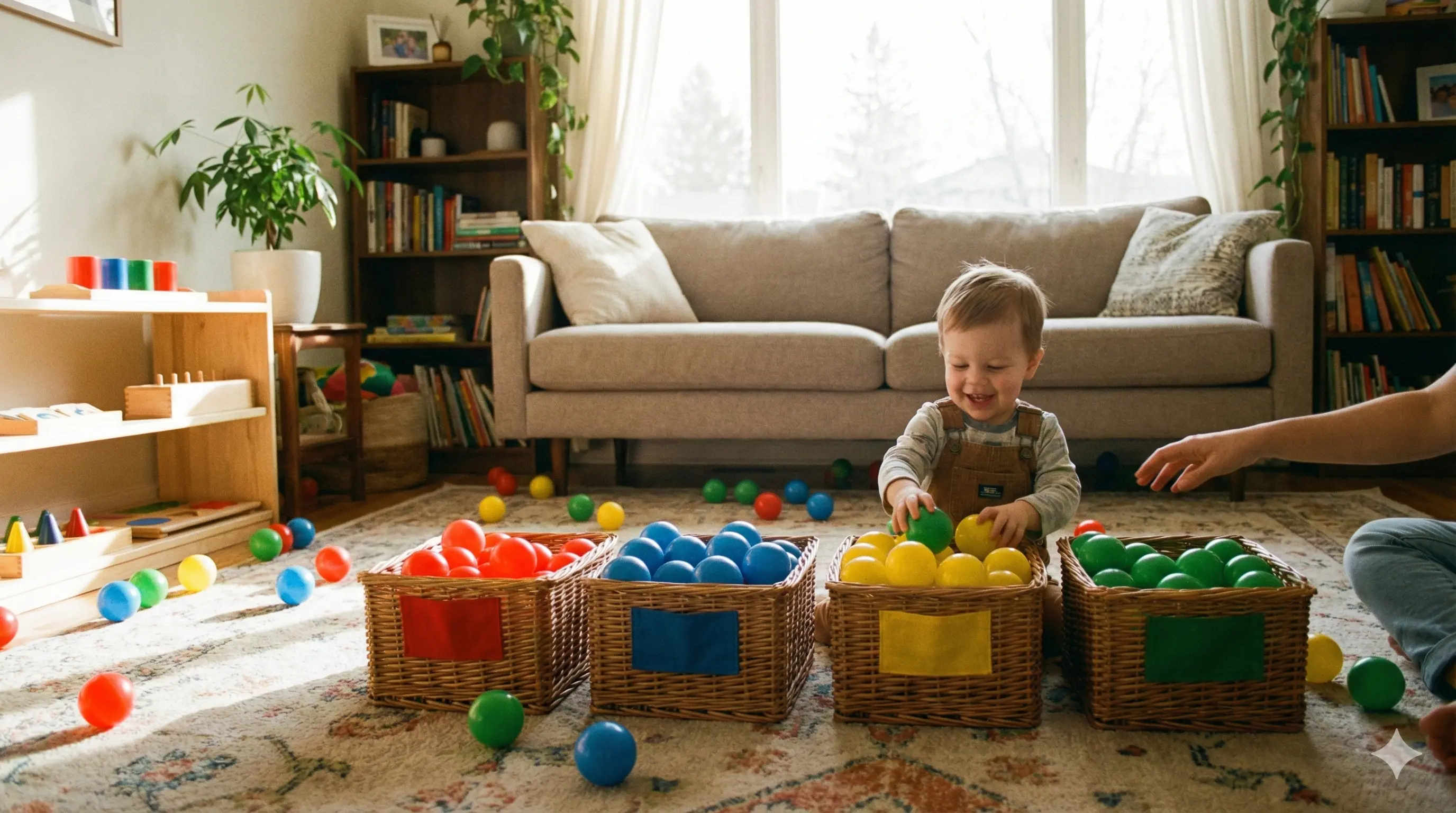
One of the most fun ways to teach the concept of colors. Classification, which is one of the fundamental activities of Montessori education, develops a child’s thinking and organizing skills.
Materials
- Ball pit balls in at least 4-5 different colors
- Separate basket, box, or bucket for each color (plastic bowl works too)
How to Play
- Place baskets of different colors on the floor or table (Blue, Red, Yellow, Green, etc.)
- Pour the balls mixed up in the middle
- Ask your child to sort the balls into the correct baskets by color
- Help at first, then wait for them to do it on their own over time
Variations
- Timed version: Keep time with a stopwatch
- Blindfold version: Sort only by touch with eyes closed
- Counted version: “Put 5 balls in each basket”
- Race version: Two children compete at the same time
Developmental Benefits
- Visual perception: Distinguishing colors
- Classification skill: Grouping similar and different items
- Hand-eye coordination: Picking up the ball and placing it in the right spot
- Concentration: Focusing on a task
Age Recommendation
12 months - 5 years (adjust difficulty according to age)
Activity 2: Bath and Water Games
Ball pit balls (if manufactured without holes) float on water without sinking. This feature turns bath time into a fun activity.
Materials
- Hole-free ball pit balls
- Bathtub or large basin
- Strainer, ladle, or plastic spoon
- Water (warm)
How to Play
- Fill the bathtub or a large basin with water
- Drop the balls in and watch them float
- Give your child a strainer and ask them to “rescue” the balls from the water
- Have them place rescued balls in a bucket
Variations
- Color hunt: “Only collect red balls”
- Number game: “Rescue 5 balls”
- Race: “Who can collect 10 balls faster?”
- Fishing: Balls are “fish,” strainer is the “net”
Developmental Benefits
- Hand-eye coordination: Catching moving targets
- Fine motor skills: Using tools (strainer)
- Gripping: Holding wet and slippery objects
- Cause and effect: “When I push it sinks, when I let go it floats”
Caution!
- Never leave a child alone in water
- Don’t make water too hot or cold
- Dry balls thoroughly after activity (mold prevention)
Age Recommendation
6 months - 4 years (always under supervision)
Activity 3: Target Practice / Basketball
Playing with heavy balls indoors can damage furniture, but ball pit balls are very lightweight. This activity is both fun and developmentally valuable.
Materials
- Ball pit balls
- Target: Laundry basket, cardboard box, bucket, or trash bin
- Optional: Tape to stick on floor (for distance marking)
How to Play
- Place a laundry basket or cardboard box at the other end of the room
- Make a throwing line on the floor with tape
- Try to throw balls into it from a certain distance
- Award points for each successful throw
- Increase the distance gradually to make the game harder
Variations
- Scored targets: Different points for different distances
- Color rules: “Red ball = 2 points, blue ball = 1 point”
- Obstacle course: The ball must pass through an obstacle
- Team game: Two teams compete
Developmental Benefits
- Distance perception: Estimating how far
- Gross motor control: Arm movements
- Targeting: Eye-hand-arm coordination
- Patience: Trying again after missing
Age Recommendation
2 - 8 years (adjust distance according to age)
Activity 4: Tunnel Adventure
This activity offers both a physical and sensory experience. Children learn to move in tight spaces and control their bodies.
Materials
- Ball pit balls (plenty)
- 3-4 chairs
- Large blanket or sheet
- Pillows (optional, to support the tunnel)
How to Play
- Line up chairs side by side to create a corridor
- Drape a blanket over them to make a long tunnel
- Fill the tunnel floor with balls
- Have your child crawl through this colorful and bumpy path
- You can place a reward at the end of the tunnel
Variations
- Treasure hunt: Find a hidden toy inside the tunnel
- Color collection: Collect balls of a specific color while passing through
- Dark tunnel: Turn off the lights (give them a small flashlight)
- Timed crossing: “Who’s the fastest?”
Developmental Benefits
- Tactile sense (sensory integration): Touching different surfaces
- Body awareness: Moving in a tight space
- Proprioception: Sensing body position
- Courage: Entering the unknown
Caution!
- Don’t make the tunnel too long (at first)
- Make sure there’s ventilation
- Make sure chairs won’t tip over
Age Recommendation
1 - 6 years
Activity 5: Spoon Carrying Race
This classic party game becomes much safer and more fun with ball pit balls. It develops balance and focus skills.
Materials
- Ball pit balls
- Large tablespoons (one for each child)
- Two buckets or baskets (start and finish point)
How to Play
- Place a ball on top of a large tablespoon
- Ask your child to carry the ball from one end of the room to the other without dropping it
- If they drop it, they start over or continue from where it fell
- If there’s more than one child, have a race
Variations
- Obstacle course: Go around chairs
- Two balls: Try putting two balls on the spoon (very hard!)
- Different spoons: Different sizes like ladle, soup spoon
- Timed: Measure the fastest time with a stopwatch
Developmental Benefits
- Balance: Walking without dropping the ball
- Focus: Keeping attention on one point
- Patience: Slow and controlled movement
- Fine motor: Keeping the spoon steady
Age Recommendation
3 - 10 years
Activity 6: Number and Math Games
Ball pit balls are perfect tools for making abstract mathematical concepts concrete.
Materials
- Ball pit balls in different colors
- Number cards or numbers written on paper
- Baskets or boxes
How to Play
Simple Counting:
- Give commands like “Put 5 balls in the basket”
- Child counts and places balls
- Gradually increase the numbers
Addition:
- “3 red + 2 blue = how many balls?” question
- Child places balls and counts
- Tells the result
Subtraction:
- Put 7 balls in the basket
- “Take out 3 balls, how many are left?”
- Child removes and counts
Variations
- Division: “Divide 6 balls equally into 2 baskets”
- Comparison: “Which basket has more balls?”
- Ordering: “Arrange from least to most”
- Guessing: “How many balls are in the jar?”
Developmental Benefits
- Number concept: Understanding quantity
- Basic math: Addition, subtraction
- Visual math: Making abstract concrete
- Problem solving: Logical thinking
Age Recommendation
2 - 7 years (difficulty adjusted by age)
Activity 7: Sensory Discovery Box
Sensory exploration, which is one of the foundations of the Montessori approach, allows children to discover the world by touching, seeing, and feeling.
Materials
- Large plastic box or pool
- Ball pit balls
- Different textures: Rice, pasta, beans (dry)
- Small toys (to be hidden)
How to Play
- Fill a large box with balls
- Hide small toys inside
- Have your child find the toys using their hands (eyes open or closed)
- Ask them to identify toys as they find them
Variations
- Blind search: Find a specific object only by touch
- Numbered search: “Find 3 cars and 2 balls”
- Timed: How many objects can you find in 1 minute?
- Mixed textures: Add soft pompoms among the balls
Developmental Benefits
- Tactile perception: Distinguishing different textures
- Stereognosis: Recognition by touch
- Fine motor: Gripping and searching
- Attention: Focusing on an invisible target
Caution!
- Small parts can pose choking hazard for children under 3
- If using food (rice, pasta), make sure they don’t put it in their mouths
Age Recommendation
1 - 5 years (choose materials according to age)
Activity 8: Bowling Game
One of the most fun activities that can be done at home, bowling becomes safe with ball pit balls.
Materials
- Ball pit balls (for throwing)
- As “pins”: Empty plastic bottles, cardboard toilet paper rolls, or plastic cups
- Optional: Glue and paper (to decorate bottles)
How to Play
- Arrange 6-10 empty bottles in a triangle shape
- Roll balls from a certain distance to knock down the bottles
- Each knocked-down bottle is 1 point
- Whoever scores the most points in 3 throws wins
Variations
- Colored bottles: Different colors = different points
- Stacked arrangement: Put bottles on top of bottles
- Different distances: Move a little further back each round
- Obstacle bowling: Put obstacles in front of bottles
Developmental Benefits
- Gross motor: Rolling motion
- Targeting: Hitting the mark
- Force control: Adjusting how hard to throw
- Social skills: Waiting for turns, accepting losing
Age Recommendation
2 - 10 years
Activity 9: Color and Shape Course
A course created on the floor allows children to follow both colors and instructions.
Materials
- Ball pit balls in different colors
- Tape or string (for drawing path)
- Optional: Music player
How to Play
- Draw a path on the floor with tape
- Place balls irregularly on the path
- Give rules like “Move forward only stepping on blue balls”
- Child completes the course according to the rule
Variations
- Musical chairs: Run to the nearest color when music stops
- Frozen ball: Freeze when a specific color is called
- Jumping game: “Step on red, jump over blue”
- Memory course: Memorize and apply the color sequence
Developmental Benefits
- Color recognition: Quick color identification
- Following instructions: Obeying rules
- Planning: Thinking about the next step
- Gross motor: Jumping, leaping, walking
Age Recommendation
2 - 7 years
Activity 10: Creative Art and Construction
Ball pit balls can also be used in creative projects.
Materials
- Ball pit balls
- Large cardboard box or board
- Paint or crayons
- Newspaper (for the floor)
How to Play
Ball Painting:
- Spread large paper in a box
- Dip balls in paints
- Roll balls over the paper
- Examine the patterns formed
Tower Building:
- Try to stack balls on top of each other (difficult!)
- Create structures with boxes and balls
- Try to build the tallest tower
Variations
- Color mixing: Blue + yellow painted balls = green trace
- Group project: Create a large painting together
- Domino effect: Line up balls and watch them all fall when you push the first one
Developmental Benefits
- Creativity: Creating original works
- Color learning: Color mixing
- Problem solving: Keeping structures balanced
- Cooperation: Working together
Age Recommendation
2 - 8 years
Safety Notes
Things to pay attention to while doing these activities:
Material Safety
- It’s important that the balls used are made from BPA-free, food-dye-compatible raw materials
- Prefer CE certified products
- Don’t use cracked, broken, or faded balls
Cleaning
- Clean balls before and after activity
- You can use warm soapy water
- You can wash them in the shower inside a mesh bag
- Dry thoroughly (to prevent mold formation)
Supervision
- Constant supervision is required especially for children under 3
- Never leave alone during water activities
- Be careful if there’s putting-in-mouth behavior
Safe Play with Erdem Toys
Using quality materials is important for safely conducting all these activities. Erdem Toys ball pit balls:
- Are EN71 certified and meet European safety standards
- Are BPA and phthalate free
- Are colored with food-grade dyes
- Are crush-proof and maintain their shape
- Offer different color and size options
To place wholesale or retail orders, visit our contact page.
Conclusion
Ball pit balls are not just for “bouncing in the pool”—they’re a perfect tool for dozens of educational activities that can be done at home. When used correctly:
- They develop motor skills
- They teach color and number concepts
- They provide sensory experiences
- They increase family interaction
- They support creativity
The entertainment and educational value you can give your child with one package of balls is far greater than its cost. Plus, you don’t even need extra materials for most of these activities—a spoon, bucket, and blanket found at home are enough!
This guide has been prepared in accordance with child development experts’ recommendations. Every child is different; adapt activities to your child’s age and interests.