Daycare and Preschool Toy Guide: Durable and Educational Solutions
Toy selection for educational institutions is different from home. A bulk toy purchasing guide for daycares and preschools featuring durable, hygienic, and group-play friendly options.
Daycare and Preschool Toy Guide: Durable and Educational Solutions
There’s a massive difference between a home toy and a classroom toy: Usage Intensity. While a child at home plays for 1-2 hours a day, the same toy in a daycare classroom is used for 8-10 hours a day by 15-25 different children. This means 10-15 times the annual home usage.
For this reason, toy selection criteria for educators and school administrators go beyond “entertainment” to focus on durability, hygiene, functionality, and pedagogical value.
In this guide, we provide a comprehensive toy selection and management handbook for daycare and preschool administrators and educators.
Fundamental Principles of Institutional Toy Selection
Differences Between Home and Institutional Toys
| Criterion | Home Toy | Institutional Toy |
|---|---|---|
| Daily use | 1-2 hours | 8-10 hours |
| Number of users | 1-3 children | 15-25 children |
| Cleaning frequency | Weekly | Daily |
| Expected lifespan | 2-5 years | 1-3 years (heavy use) |
| Part quantity need | Few | Many (for group play) |
| Safety risk | Low | High (supervision difficulty) |
Selection Criteria Hierarchy
- Safety (non-negotiable)
- Durability (cost-effectiveness)
- Hygiene (health)
- Pedagogical value (education)
- Storage convenience (practicality)
- Price (budget)
1. Durability and Material Quality
In a classroom environment, toys fall, collide, get thrown, and sometimes get stepped on. Durability is critical for both safety and cost.
Material Selection
Preferred Plastics:
- ABS Plastic: Impact-resistant, hard but unbreakable
- Polypropylene (PP): Flexible, chemical-resistant
- Polyethylene (PE): Lightweight, durable, low cost
Materials to Avoid:
- Brittle polystyrene (PS)
- Thin-walled plastics
- Easily peeling painted surfaces
Structural Soundness
Points to Consider:
- Monobloc design: Single-piece production whenever possible
- Weld points: Strength of joint areas
- Wheel mounting: Metal axles preferred
- Handles and grips: Should be tested against breaking
Practical test: Drop the toy from 1.5 meters (5 feet) onto hard floor. There should be no breaking or part detachment.
Part Integrity
Cars with easily detached wheels or shovels with handles that break off cause problems in a classroom environment:
- Lost part chaos
- Safety risks (small parts)
- Conflicts between children (“My car’s wheel got lost!“)
2. Hygiene and Cleanability
Toy hygiene is critical to prevent the spread of infectious diseases in schools. This topic has become even more important in the post-COVID-19 era.
Surface Properties
Ideal surface:
- Smooth and non-porous
- Few indentations and protrusions
- Quick-drying
- Resistant to color fading
Problematic surfaces:
- Deep indentations (bacteria nests)
- Fabric coverings (retain moisture)
- Stickers (peel off, hygiene issue)
Cleaning Protocol
Daily cleaning:
- Toys that go in mouths (teethers, rattles, etc.)
- High-contact surfaces
Weekly cleaning:
- All plastic toys
- Building blocks
- Vehicles and figures
Monthly deep cleaning:
- Fabric toys (washing)
- Large equipment
- Storage containers
Cleaning Methods
For plastic toys:
- Wiping with warm soapy water
- 70% alcohol-based disinfectant
- Dishwasher washing (top rack, low temperature)
For fabric toys:
- Washing machine at 60°C (140°F)
- Dryer (high heat kills germs)
- UV sterilization (if available)
Warning: Chlorine-based disinfectants can damage plastic surfaces. Check manufacturer recommendations.
3. Multi-Play Compatibility (Group Dynamics)
Toy selection should be strategic to minimize “This is mine!” fights in the classroom and encourage cooperative play.
Part Quantity Planning
General rule: At least 2-3 times the number of children in the class
| Toy Type | Minimum for 15 children | Minimum for 20 children |
|---|---|---|
| Building blocks | 200-300 pieces | 300-400 pieces |
| Vehicles | 20-25 units | 30-35 units |
| Kitchen set pieces | 40-50 pieces | 60-70 pieces |
| Figures | 25-30 units | 35-45 units |
Cooperative Play Sets
Large Building Sets:
- Block boxes with 50-100 pieces
- Allow 4-5 children to play around the same table at once
- Opportunity for collaborative projects (class castle, village building)
Role-Playing Corners:
- Kitchen corner: Enough variety of parts for 4-5 children to play simultaneously
- Repair corner: Enough tools for each child
- Market corner: Sufficient products, cash register, and baskets
Rule-Based Toys:
- Turn-taking games
- Designs that require sharing
- Group-goal activities
Corner Arrangement
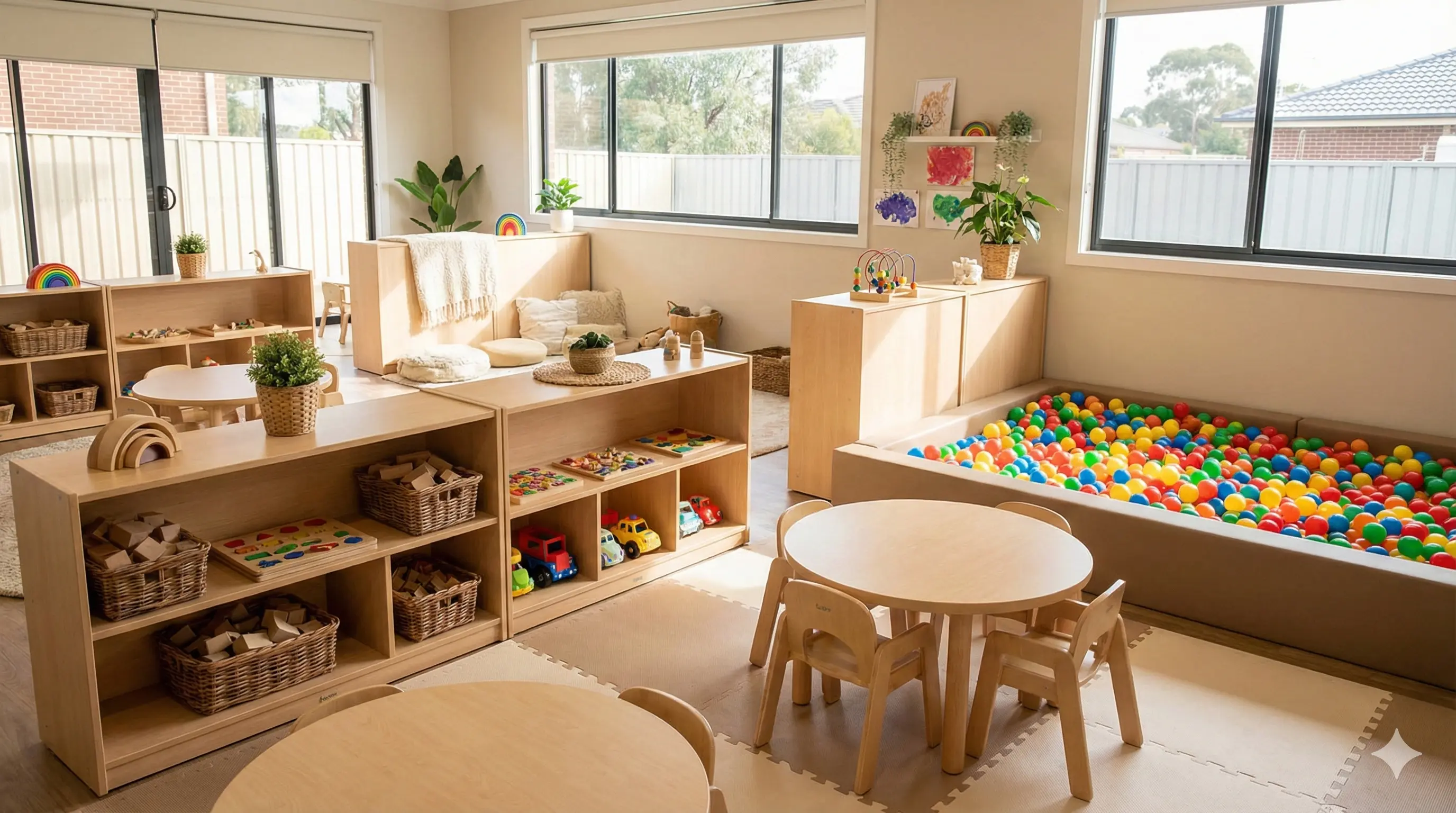
Recommended corners for a typical daycare classroom:
- Building Corner: Blocks, construction sets, vehicles
- Dramatic Play Corner: Kitchen, market, baby care
- Art Corner: Painting, dough, cutting-pasting
- Book Corner: Picture books, puppets
- Science/Nature Corner: Magnifying glass, plants, sensory bins
- Music Corner: Simple instruments
4. Storage and Organization
The classroom needs to be tidied up at the end of the day. A weak storage system causes:
- Teacher fatigue
- Lost parts
- Disorganized classroom appearance
Storage Solutions
Features to look for:
- Transparent containers (see contents)
- Stackable design
- Easy-open lids (children can use them too)
- Label area (for picture labels)
- Large wheeled containers
Stackable Toys:
- Nesting buckets
- Foldable houses/garages
- Modular building sets
- Basket systems
Cleanup Ritual
Gamify the daily cleanup activity:
- Cleanup starts when the “cleanup song” plays
- Color-based task distribution (“Who’s picking up the blue toys?”)
- Emphasis on cooperation, not competition
5. Toy Selection by Age Group
0-1 Years (Baby Group)
Priority: Safety and sensory stimulation
- Soft, washable toys
- Large pieces that can’t be swallowed
- Sensory books
- Mirror toys
- Teethers (personal use)
Note: Hygiene is most critical in this age group. A separate teether set for each baby is recommended.
1-2 Years (Toddler Group)
Priority: Motor development and exploration
- Large-piece blocks
- Push-pull toys
- Simple shape sorters
- Soft balls
- Sound-making toys
2-3 Years (Early Childhood)
Priority: Language and social development
- Role-playing sets (simple)
- Medium-sized blocks
- 2-4 piece puzzles
- Play dough
- Large bead threading sets
3-6 Years (Preschool)
Priority: Imagination and academic preparation
- Comprehensive role-playing corners
- Complex building sets
- Puzzles (12-24 pieces)
- Letters and numbers
- Board games (simple)
6. Budget Planning and Cost Optimization
Total Cost of Ownership (TCO) Approach
A cheap toy isn’t always economical:
| Toy Type | Initial Cost | Lifespan | Annual Cost |
|---|---|---|---|
| Cheap plastic car | $3 | 3 months | $12 |
| Quality plastic car | $8 | 2 years | $4 |
Result: Quality toy is 3 times more economical!
Budget Distribution Recommendation
Distribution of annual toy budget:
- 40%: Building and construction toys (long-lasting)
- 25%: Role-playing sets
- 15%: Sensory and motor development
- 10%: Art supplies (consumables)
- 10%: Replacement and reinforcement
Bulk Purchase Advantages
For institutional customers:
- Volume discounts (15-30%)
- Invoice and official documentation
- Bulk warranty
- Customized packages
- Delivery service
7. Safety and Regulations
Required Certifications
For daycare and preschool toys in Europe and Turkey:
- CE mark: Required
- EN71 compliance: Required
- National standards certification: Recommended
Regular Inspections
Daily:
- Broken/damaged toy check
- Loose part check
- Cleanliness status
Weekly:
- Lost parts inventory
- Detailed safety scan
Monthly:
- Comprehensive inventory
- Wear assessment
- Discard/replace decisions
Documentation
Records to maintain:
- Toy inventory list
- Purchase invoices and certificates
- Cleaning/disinfection log
- Damage/accident reports
8. Practical Tips for Educators
Toy Rotation
Instead of putting all toys out at once, apply rotation:
Benefits:
- Children’s interest stays fresh
- Toy lifespan extends
- Classroom stays more organized
- New toy purchase needs decrease
Implementation:
- Divide toys into 3-4 sets
- Change one set each month
- Add seasonal themes (summer toys, winter toys)
Toy Introduction
When introducing new toys to the classroom:
- Introduce during group time
- Explain usage rules
- Demonstrate correct use
- Give a few children a chance to try
- Then open to everyone
Problem Solving
For “This is mine!” fights:
- Provide sufficient part quantities
- Use timers (taking turns playing)
- Suggest alternatives
For broken toys:
- Remove from classroom immediately
- Explain to children
- Repair if possible, otherwise discard
Conclusion
Daycare and preschool toy selection is based on very different criteria than the home environment. The right choices:
- Ensure children’s safety
- Increase education quality
- Protect budget in the long term
- Make teachers’ jobs easier
At Erdem Toys, with over 30 years of experience, we offer educational institutions:
- Bulk sale advantages
- Institutional invoicing
- EN71 certified products
- Durability-focused designs
- Free toy consulting
Contact us to get a custom quote for your institution.
This guide has been compiled from the experiences of early childhood education experts and daycare administrators. We recommend following publications from the Ministry of Education and relevant institutions for current regulations.