Why Do Ball Pit Balls Deflate? How to Identify Quality Balls
Why do the ball pit balls you bought lose their shape or go flat over time? Technical insights about plastic thickness, raw material quality, and crush resistance tests.
Why Do Ball Pit Balls Deflate? How to Identify Quality Balls
Ball pit balls look like simple, air-filled plastic spheres from the outside. However, while some balls in the market maintain their form for years, others are seen to “deflate” or “deform” within just a few weeks. Even balls from two different brands purchased at the same price can perform completely differently.
So, as a consumer, how can you tell the quality when you hold the product in your hands? Here are objective criteria based on manufacturing techniques and key points you need to pay attention to.
How Are Ball Pit Balls Manufactured?
Understanding the production process helps make sense of quality criteria.
Production Stages
- Raw Material Preparation: PE (Polyethylene) or PP (Polypropylene) granules are melted
- Molding: Molten plastic is injected into spherical molds or shaped using blow molding
- Cooling: Balls from the mold are cooled in a controlled environment
- Quality Control: Weight, diameter, and flexibility tests are conducted
- Packaging: Balls are placed in nets or bags
Blow Molding vs Rotational Molding
Blow Molding:
- Thinner and uniform wall thickness
- Lighter products
- Economical production
- Generally used for home-use balls
Rotational Molding:
- Thicker and more durable walls
- Heavier products
- Higher cost
- Preferred for commercial-grade balls
1. Why Do Some Balls Self-Deflate?
Ball pit balls are not inflated with a pump. The air trapped inside during production gives the ball its shape. In balls made from low-quality or very thin plastic, “Thermal Expansion and Contraction” issues occur.
Temperature Factor
- In Cold Conditions: In winter or cold storage, the air inside the ball contracts. If the plastic shell is too thin, it cannot withstand external pressure and the ball collapses inward (appears deflated).
- In Hot Conditions: In heat, the plastic softens excessively and loses its form. Balls stored above 40°C (104°F) can suffer permanent deformation.
Ideal Storage Conditions
To extend the lifespan of your balls:
- Store in environments between 10-30°C (50-86°F)
- Protect from direct sunlight
- Keep humidity below 70%
- Don’t leave under heavy objects
A quality ball’s wall thickness should be thick enough to resist these temperature changes, yet flexible enough not to harm children. Generally, 0.8mm-1.2mm wall thickness is considered ideal.
2. Crush Resistance Test: Hardness or Flexibility?
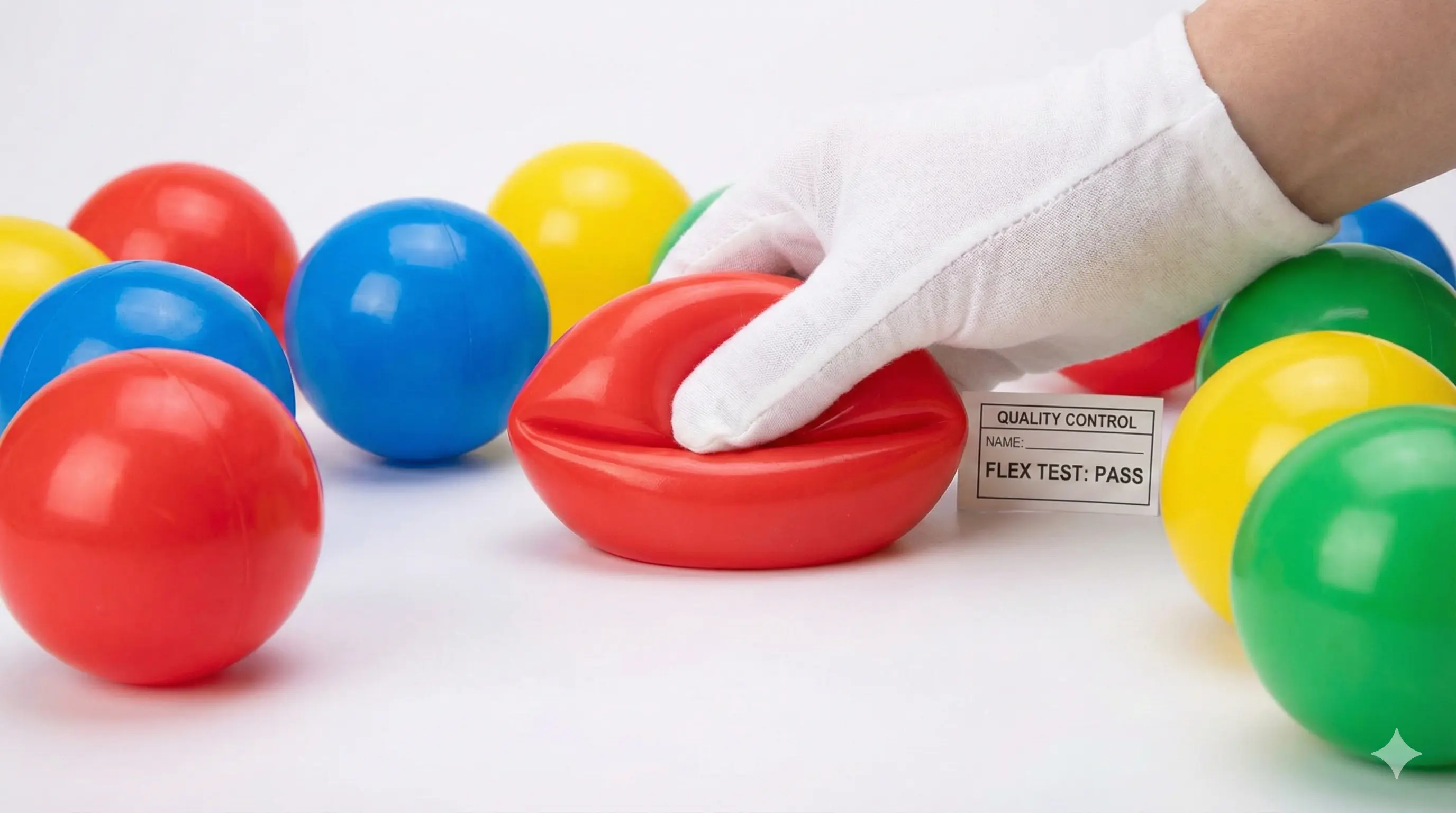
A common misconception is that a “hard ball” is more durable. On the contrary, hard plastic is brittle. When stepped on, it cracks or permanently deforms.
An ideal ball pit ball should be flexible.
Tests You Can Do at Home
Test 1: Hand Press Test
- Press down on the ball with your hand
- The ball should flatten (flex)
- When you release pressure, it should return to its round shape within 2-3 seconds
Test 2: Foot Press Test
- Place the ball on a hard surface
- Press lightly with your foot (don’t apply full weight)
- The ball should flatten completely and return to its original shape
Test 3: Drop Test
- Drop the ball from 1.5 meters (5 feet) onto a hard surface
- A quality ball bounces back
- A low-quality ball stays in place or bounces very little
Test 4: Squeeze Test
- Squeeze the ball with both hands
- Internal pressure should distribute evenly
- If there’s a “collapse” feeling at any point, wall thickness is uneven
When Should You Worry?
If when you press:
- White stress marks appear on the ball
- The ball doesn’t return to its original shape
- You hear a crackling sound
- The plastic looks “tired”
…that product has a very short lifespan and needs to be replaced.
3. Raw Material Types and Characteristics
Plastic balls can be manufactured from different raw materials. Each has advantages and disadvantages.
PE (Polyethylene)
The most commonly used raw material.
Advantages:
- Flexible and durable
- Low cost
- Recyclable
- Chemically stable
Disadvantages:
- Sensitive to UV rays (can fade)
- Softens at very high temperatures
PP (Polypropylene)
A harder alternative.
Advantages:
- Higher melting point
- Harder structure
- Good chemical resistance
Disadvantages:
- More brittle
- Can crack in cold
- More expensive
LDPE vs HDPE
LDPE (Low-Density PE):
- More flexible
- Softer feel
- Preferred for baby products
HDPE (High-Density PE):
- Harder
- More durable
- Used in commercial products
4. Color and Dye Quality
The color of balls is not just aesthetic—it’s also a quality indicator.
Original vs Recycled Raw Material
Original (Virgin) Raw Material:
- Bright, vibrant colors
- Homogeneous color distribution
- No smell or very faint
- Long-lasting color
Recycled Raw Material:
- Matte, faded colors
- May have spots or streaks in color
- Heavy plastic smell
- Color fades over time
Dye Types
In-Mold Coloring:
- Color is mixed into raw material
- Won’t scratch, won’t fade
- More expensive but safer
Surface Painting:
- Painted after production
- Can scratch, can peel
- May pose risk when put in mouth
5. Smell Test and Health
Since children are likely to put balls in their mouths, the smell test is critically important.
Normal vs Abnormal Smell
Acceptable:
- Light, neutral plastic smell
- Smell that dissipates after a few days of airing
- Unnoticeable, non-disturbing smell
Warning Sign:
- Sharp, burning smell
- Chemical/solvent smell
- Persistent smell that doesn’t go away with airing
- Nauseating smell
Why Do Some Balls Smell So Strong?
- Cheap plasticizers: Substances like phthalates create odor
- Insufficient curing: Production was rushed
- Recycled material: Mix of different plastics
- Poor storage: Kept in enclosed spaces
What Should You Do?
If newly purchased balls smell:
- Air them out for 2-3 days in open air
- Wash with warm soapy water
- Let dry in sunlight (but not extreme heat)
- If they still smell, don’t use them
6. Certifications and Standards
Standards required for safe ball pit balls:
CE Mark
Required for sales in the European Union market. Indicates that basic safety requirements are met.
EN71 Standard
The most comprehensive standard for toy safety:
- EN71-1: Mechanical and physical properties
- EN71-2: Flammability
- EN71-3: Migration of certain elements (heavy metals)
- EN71-9: Organic chemical compounds
Points to Note
- Manufacturer information should be on the packaging
- Age warning should be stated
- Batch/lot number should be present
- Importer information (for imported products) should be included
7. Price-Quality Relationship
The saying “you get what you pay for” applies to ball pit balls too.
Why Are Some Balls So Cheap?
- Thinner wall thickness
- Use of recycled raw material
- Lack of quality control
- Uncertified production
- Cheap dyes and additives
Long-Term Cost
If the cheap balls you bought for $20 break down in 2 months and you need to buy new ones, versus quality balls for $30 that last 2+ years, which is really more economical?
Where to Buy?
- From reliable stores
- Branded products
- With invoice/warranty
- By checking certifications
Erdem Toys Quality Approach
With over 30 years of experience, we prioritize quality in ball pit ball production. Our products:
- Are EN71 certified and meet all European standards
- Are made from original LDPE raw material
- Are BPA and phthalate free
- Are colored with food-grade dyes
- Pass strict quality control
To learn about our wholesale and retail options, visit our contact page.
Frequently Asked Questions
Why do balls lose color over time?
Plastics exposed to UV rays fade over time. Quality products contain UV stabilizer additives, and fading occurs much more slowly. You can extend the lifespan of balls by protecting them from direct sunlight.
Can I fix crushed balls?
For minor dents, you can submerge the ball in warm water (40-50°C / 104-122°F) for a few minutes. The plastic softens slightly and may return to its form. However, permanent deformations are generally irreversible.
How often should I replace balls?
Quality balls can last 3-5 years under normal use. However, if you notice color fading, loss of flexibility, or odor development, it’s time to replace them.
Can I mix balls from different brands?
You can mix them as long as they’re compatible in size and firmness. However, using balls of very different quality together may cause the quality ones to wear out faster.
Conclusion
A quality ball pit ball:
- Is odorless or has very faint neutral smell
- Is flexible - deforms when squeezed but immediately returns to shape
- Has vibrant colors and color is homogeneous
- Is certified - has CE and EN71 marks
- Maintains its form through seasonal changes
By paying attention to these criteria, you protect both your child’s health and make a long-lasting investment. Remember, our children’s safety is more important than anything.
This guide has been prepared to help you make informed decisions about ball pit ball selection. Contact us with your questions.